Jobs and Occupations in English for Kids
There are about a dozen job words most children meet first — doctor, teacher, farmer, chef, firefighter, and a handful more — and a young learner can hold them after a week of short, playful practice. This guide to Jobs and Occupations in English for Kids: Words and Activities gives you a teachable word set, simple sentence patterns, and games sorted by age. You do not need a classroom or a printout to begin; a walk past a bakery or a fire station is enough to start naming the people your child already sees every day.
📥 Jobs and Occupations Practice Pack
Vocabulary, sentences, home practice, and easy fixes
Leave your email — we'll send the PDF to your inbox.No spam — the PDF plus one short reminder. Unsubscribe anytime.
Core Job Words to Teach First
Start with jobs your child can picture. A word sticks faster when it has a face, a place, and one clear action behind it. Here are fourteen words that cover most early conversations, each with a short plain meaning you can repeat out loud.
- Doctor — helps sick people feel better
- Nurse — cares for patients in a hospital
- Teacher — helps children learn at school
- Farmer — grows food and cares for animals
- Chef — cooks meals in a kitchen
- Baker — bakes bread and cakes
- Firefighter — puts out fires and keeps people safe
- Police officer — keeps people safe and helps them
- Dentist — looks after teeth
- Vet — helps sick animals
- Pilot — flies planes
- Driver — drives a bus, a taxi, or a truck
- Artist — paints and draws pictures
- Builder — builds houses and roads
Once your child knows a few words, group them by place. This small table links each job to where the person works and one tool they hold, which turns a single word into a little scene your child can act out.
Jobs in Everyday Sentences
Words alone rarely lead to speaking. Children need a frame to drop the words into, so teach three short patterns and reuse them for every job. The first is "A doctor works in a hospital." The second is "A firefighter helps people." The third is a question: "What does a farmer do?"
Model the pattern, then let your child fill the blank. Point at a picture and ask, "What does a chef do?" and wait. A one-word answer ("cooks") is a win; a full sentence comes later. The word set in this Jobs and Occupations in English for Kids: Words and Activities guide fits these frames on purpose, so any new job slots straight into a sentence your child already knows.
Keep the talk about real people too. When you pass a bus, say "The driver drives the bus." Naming the world as you move through it gives each word a home, and our tutors lean on this same trick across LearnLink lessons.
Activities by Age
The same twenty words suit a five-year-old and a twelve-year-old, but the game around them changes. Match the activity to what your child can already do, and the words carry over.
School-age kids: Play "job actions." You say a job, your child mimes it — a firefighter sprays a hose, a chef stirs a pot. Movement locks the word into memory better than repetition does at this age. Picture cards and pointing games work well here.
School-age kids: Try "who am I?" Your child describes a job in three clues — "I help animals. I work with pets. I am a…" — and you guess. This pushes them from single words into full sentences. Simple riddles from the Jobs and Occupations in English for Kids: Words and Activities set make good clue cards.
School-age kids: Move to real talk. Ask what job they would like and why, or compare two jobs: "A vet and a doctor both help others, but one works with animals." Older children can handle tools, workplaces, and reasons in one answer.
Practice Ideas at Home
Short and often beats long and rare. Five minutes a day, tied to something you already do, keeps the words alive without feeling like homework. Cooking dinner? Name the chef. Driving to school? Name the driver. Building blocks? Name the builder.
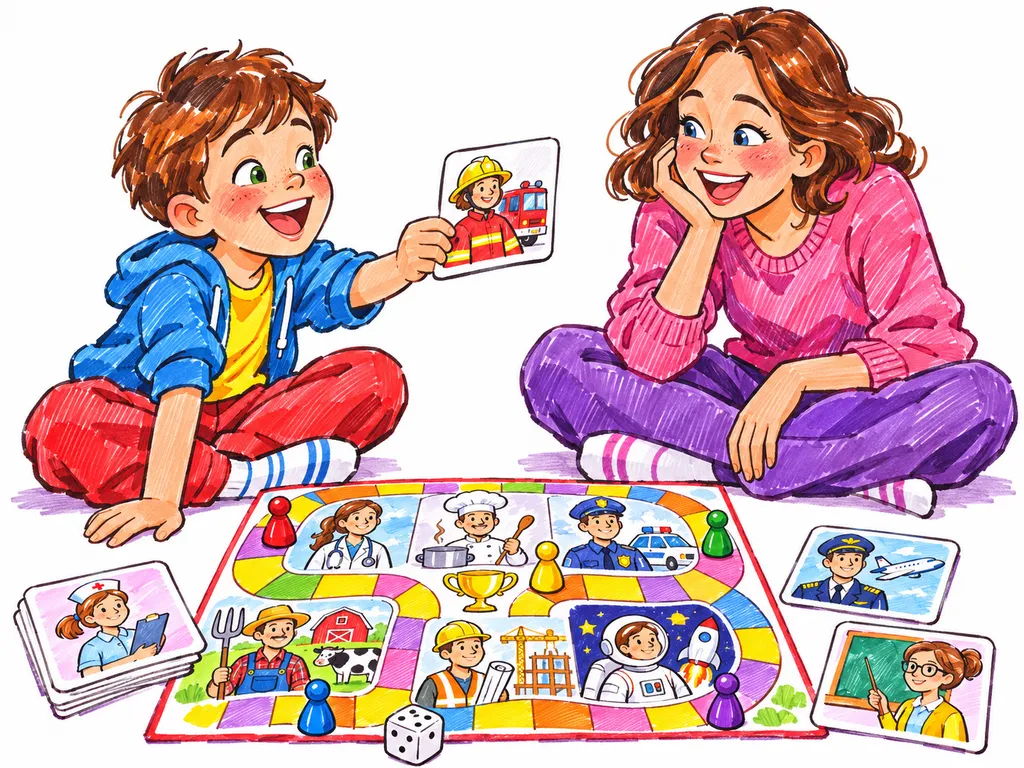
A few printed pictures or hand-drawn cards go a long way. Turn them face down and let your child flip two at a time — a job and its workplace — to make a pair. The practice ideas in this Jobs and Occupations in English for Kids: Words and Activities plan need no special kit, just a minute here and there.
Guess the Job Game
Read a clue and let your child name the job. 1) "I fly a plane. Who am I?" 2) "I put out fires. Who am I?" 3) "I look after your teeth. Who am I?" 4) "I grow food on a farm. Who am I?" Then swap roles and let your child give you the clues — inventing a clue is harder than answering one, and it shows how well the words have settled.
Common Mistakes and Easy Fixes
A few slips show up in almost every child, and none of them signal a problem. Naming them early saves confusion later.
The first is the article. Children say "a artist" when the rule needs "an artist," because the word starts with a vowel sound. A quick reminder — "an" before a, e, i, o, u sounds — clears most of these up over time.
The second is dropping half the word. Kids say "he is police" instead of "he is a police officer." Gently repeat the full form; do not stop the flow to correct mid-sentence. The third is old gendered words like "policeman" or "fireman." Teach "police officer" and "firefighter" from the start, so your child learns the current, neutral form once rather than relearning it later.
- Play a 5-minute job-charades game each evening using 6 flashcards.
- Practice one occupation sentence pattern daily, like "A teacher teaches students."
- Review yesterday's mixed-up words together before bedtime for two minutes.
- Ask your child to name three family members' jobs using full sentences.
- Read one picture book about community helpers this week to reinforce vocabulary.
When a word has several meanings or pronunciations, Cambridge Dictionary is a useful check before turning it into child-friendly examples.
Frequently Asked Questions
How Many Job Words Should My Child Learn at Once?
Start with five, not fifteen. A young child holds a small set far better than a long list, so pick five jobs your child sees often — teacher, doctor, driver, chef, farmer — and practise those until they come easily. Add five more the following week. The full Jobs and Occupations in English for Kids: Words and Activities set is meant to be taught in small groups over several weeks, not memorised in one sitting.
At What Age Can We Begin Teaching Job Words?
Around age four is a natural start, once your child names people and places in their home language. At this age, keep it to miming and pointing rather than spelling or writing. Older children can handle workplaces, tools, and reasons in the same lesson. The words themselves suit any age from four to fifteen; only the activity around them changes.
My Child Mixes up "Job" and "Work." Is That Normal?
Yes, and it is common in many languages. Explain it simply: a job is the name of what someone does, like "doctor," and work is the doing of it. "Her job is a nurse. She works in a hospital." A short, repeated example lands better than a rule, so use real people your child knows.
Do We Need Flashcards or an App to Practise?
No. Real life gives you free material every day — the baker, the bus driver, the person building the house next door. Point, name, and repeat. Hand-drawn cards or a few printed pictures help, but they are optional. What matters is naming jobs often and in short bursts rather than owning a special tool.
A short one-to-one lesson can show what level and pace fit your child — book a trial English lesson.
Stay updated on our latest tips and resources by following us on Instagram LearnLink.